
🏗️ What is a Concrete Finisher and Why is it Important for Your Projects?
🎯 What is a Concrete Finisher (Concrete Laying Machine)?
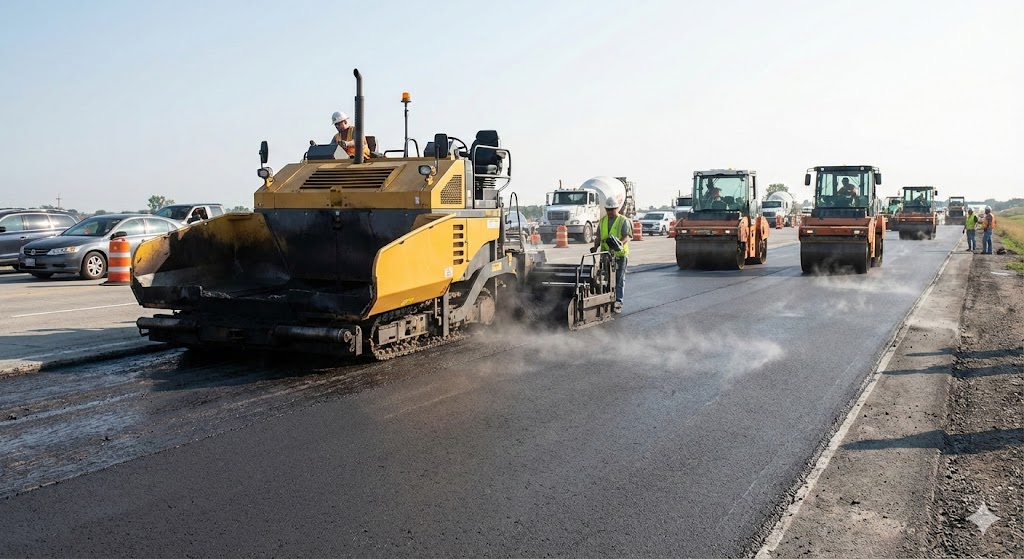
A concrete finisher is a heavy-duty construction machine commonly used to create high-quality, smooth-surfaced concrete pavements on large areas such as roads, highways, airport runways, irrigation canals, and large industrial floors. These machines accept concrete from transit mixers or concrete plants, spread it to the specified thickness and width, compact it with vibration, and finally perform surface treatments (screeding and troweling) to obtain a smooth surface.
Concrete pavers offer the following critical advantages compared to manual paving:
-
Speed and Efficiency: Completes large-volume concrete pours in a much shorter time.
-
Quality and Homogeneity: Provides high surface quality by spreading the concrete within the desired slope, height, and uniformity tolerances.
-
Labor Savings: Significantly reduces the amount of labor required in large areas.
 🛠️ Working Principle and Types of Concrete Finishers
The basic working principle of concrete finishers is to continuously spread and shape fresh concrete while it moves within a mold or template.
Slipform Concrete Finishers
These finishers are the most common and modern type, and have a special formwork system that takes the shape of the concrete while it moves, and then leaves a solid and independent concrete structure behind the mold.
-
Application Areas: High-speed roads, highways, airport runways, barriers (New Jersey barrier), pavements and canals.
-
Advantage: Thanks to its ability to perform continuous pouring, it gives the best results in very high-volume projects and creates fewer joints.
-
Technology: The machine generally uses automatic tilt and direction control systems such as lasers, sonic sensors or 3D modeling (Total Station) to maintain the correct height and alignment.
Fixed-Form Concrete Finishers
This type is based on the principle of pouring concrete between pre-placed and fixed steel or wooden molds. The finisher compacts and levels the concrete by moving over the molds.
-
Application Areas: Narrower or more complex projects, such as city roads, bridge approach slabs, or smaller industrial floors.
-
Advantage: It has a simpler mechanism and may be sufficient for less complex projects.
🏗️ How to Choose the Right Machine for Your Projects?
Choosing the right concrete finisher is critical in terms of the project’s budget, timeline, and final quality expectations. You should consider the following factors:
1. Project Type and Volume
-
Large Highways/Runways: High-capacity, 4-track or 2-track Slipform pavers with a wide working width should be preferred. Continuity is essential.
-
Channels/Barriers/Sidewalks: Purpose-specific, narrower and more flexible Channel/Barrier finishers (small slipform machines usually focusing on a single mold) are most suitable.
-
Industrial Floors: Depending on the size of the project, both slipform and fixed-form (especially large floor screeds) can be used.
2. Working Width and Capacity
-
The maximum and minimum width that the machine can lay in a single pass must be compatible with the pavement widths in your project. For example, when laying a 7.5-meter road, a machine that can handle this width should be selected.
-
Laying Depth (Thickness): The maximum concrete thickness that the machine can lay (e.g., 40 cm) should not be less than the concrete slab thickness in your project.
3. Movement System and Maneuverability
-
Tracked Finishers: Generally used in large slipform finishers. High traction, heavy load carrying capacity and provides smooth progress.
-
Wheeled Finishers: Suitable for smaller and more maneuverable machines, but not preferred in large paving projects.
4. Automatic Control and Technology
-
For projects requiring high precision (especially airport runways), machines compatible with 3D control systems (Total Station/GPS) and equipped with the latest technology should be selected. These systems ensure that the concrete surface is laid with millimeter tolerances.
-
Vibration System: The vibration system and the number of vibrators of the paver are important for compacting the concrete to the desired density.
🧐 In Summary
Concrete pavers are the cornerstone of large-scale infrastructure projects. Choosing the right machine means not only finishing the job, but also completing the project with the highest quality, in the shortest time and at the lowest cost. Clarifying your project details (width, depth, tolerances) is the first step in determining the most suitable paver type and model.