
Advantages of Slipform Technology in Concrete Road Construction
🛣️ A Revolution in Concrete Road Construction:
The speed and quality of modern infrastructure projects are directly related to the technology used. Especially when it comes to highways, airport runways, and roads exposed to heavy load traffic, durability and longevity become the primary priority. This is where Slipform Technology comes into play, challenging traditional fixed formwork methods. This method offers undeniable advantages that go beyond simply using a machine, elevating concrete road construction to the level of an art and engineering marvel.
🚀 Speed, Continuity and High Efficiency
Perhaps the greatest benefit of slipform technology is that it dramatically shortens the completion time of projects.
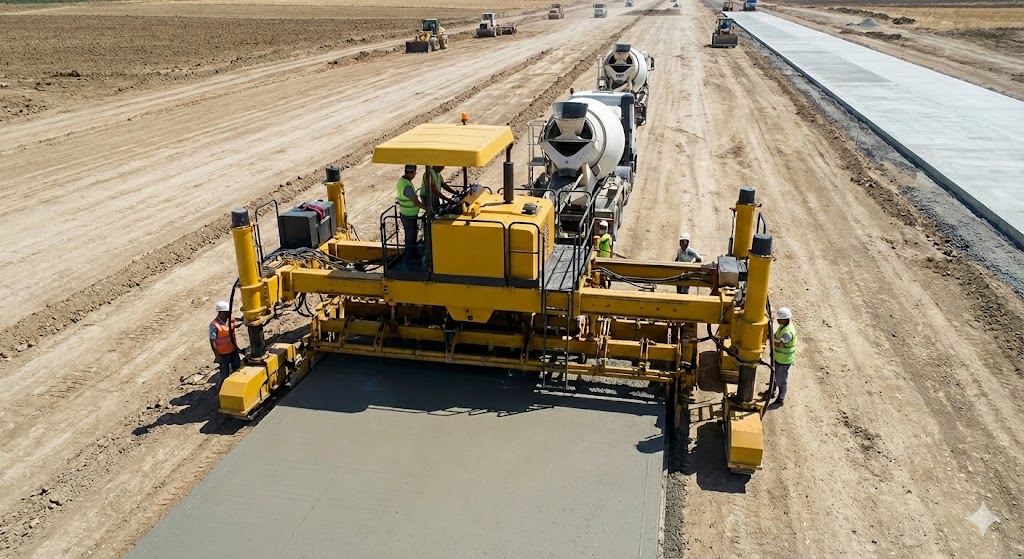 Fast and Uninterrupted Paving
In traditional methods, steel or wooden formwork must be carefully installed, secured, and allowed to harden before concrete pouring. This naturally interrupts the workflow. The slipform paver, however, moves by continuously carrying a steel template that acts as a formwork.
-
Production at the Rim: As the machine progresses, the fed fresh concrete is instantly laid, compacted by vibration, and shaped. This continuous pouring capability means that kilometers of road can be built per day.
-
Labor Optimization: Since formwork erection and dismantling operations are eliminated, the labor required for the project is reduced, and these resources can be directed to critical tasks such as concrete supply and surface finishing.
✨ Superior Surface Quality and Durability
Riding quality, one of the most important features of concrete roads, is maximized thanks to sliding formwork technology.
Automatic Slope and Direction Control
Sliding formwork finishers are not simple machines; These are advanced engineering systems. Modern pavers are equipped with laser, sonic sensors or 3D/GPS control systems (Total Station).
-
Millimeter Precision: These systems ensure that the machine continuously moves according to a predetermined path plan (slope, height and direction). This minimizes human error, offering a smoothness in millimeter tolerances that is difficult to achieve with manual molds. The reduction of surface undulations ensures a more comfortable and safe journey for the vehicle.
-
Homogeneous Compaction: Multiple vibrators inside the machine compact the concrete evenly and homogeneously throughout the entire cross-section. This compaction helps to achieve high density and ultimate strength by ensuring that no air voids remain in the concrete.
💰 Long-Term Economic Advantages
Although it requires a high initial investment cost, slipform technology provides significant economic benefits to projects in the long run.
Less Maintenance and Repair Needs
Concrete roads laid with slipforms generally contain fewer joints (due to continuous pouring) thanks to their high quality.
Furthermore, high homogeneity in compacting the concrete reduces the risk of crack formation and premature deterioration.
-
Longer Service Life: A quality concrete pavement offers a much longer service life compared to asphalt roads (typically 30-40 years). This significantly reduces the maintenance, repair, and renewal costs required throughout the road’s lifecycle.
-
Material Efficiency: Thanks to precise control systems, concrete loss is minimized, and pouring is done precisely to the designed cross-sectional dimensions.
🧩 Flexibility and Versatility
Sliding formwork technology is not limited to flat road pouring. It offers flexibility in a wide range of applications using different attachments and formwork systems.
MostApplication Areas for Two Directions
-
Barriers and Channels: Specially designed small slipform pavers can produce New Jersey type traffic barriers, irrigation channels and curb and gutter in a single pass, with high speed and quality. This means that different infrastructure elements can be built quickly with the same technology.
-
Variable Width: Modern paver models, thanks to adjustable formwork systems, can lay lanes of different widths with the same machine, which optimizes equipment investment.
In conclusion, slipform technology has redefined concrete road construction with high precision, unparalleled efficiency, and long-term economic advantages. This technology empowers engineers to build infrastructure that is not only durable but also of a quality that will serve future generations. If speed, quality, and longevity are the goals in a project, choosing slipform is no longer a preference but a necessity.